


Navigating the Future: Why Modern Marinas Must Switch to Fiber Optic Networks

Updated: Aug 26
For decades, marinas were viewed simply as parking lots for boats—places where a slip, a cleat, and a basic power pedestal were all a captain required. Today, the landscape is entirely different. Modern boaters step off their vessels expecting the same amenities they enjoy at five-star resorts, chief among them being seamless, high-speed internet.
Whether it is a remote worker logging into a corporate VPN from a yacht, a family streaming 4K movies on a rainy afternoon, or a captain updating complex navigation and weather software, bandwidth demands at the dock have skyrocketed.
While many marinas still rely on traditional copper wiring (like Coaxial or Cat6) or point-to-point wireless networks, these legacy technologies are buckling under the pressure. To stay competitive, modern marina operators must look to the ocean-proof, future-proof gold standard of connectivity: Fiber Optics.
The Unique Connectivity Challenges of Marinas
Marinas are among the most hostile environments on earth for digital infrastructure. They face a perfect storm of environmental and technical challenges that traditional copper networks simply weren't built to handle:
The Corrosion Factor: Saltwater, humidity, and constant moisture are lethal to copper. Over time, copper wires oxidize, leading to degraded signals, dropped connections, and costly, recurring maintenance cycles.
Extreme Distances: Marinas often feature long, sprawling docks that stretch hundreds or thousands of feet from the main shoreside office. Copper cables have strict distance limitations (usually around 300 feet for standard Ethernet) before signal degradation occurs.
Electrical Interference (EMI): Marinas are packed with high-voltage shore power cables, transformers, and massive boat generators. When copper data cables run alongside these power sources in narrow dock utility troughs, electromagnetic interference ruins data integrity.
Physical Obstructions: Boats are giant floating obstructions made of fiberglass, steel, and aluminum. A point-to-point Wi-Fi network attempting to blast signals across open water will inevitably hit a wall of superyacht hulls, resulting in dead zones and frustrated customers.
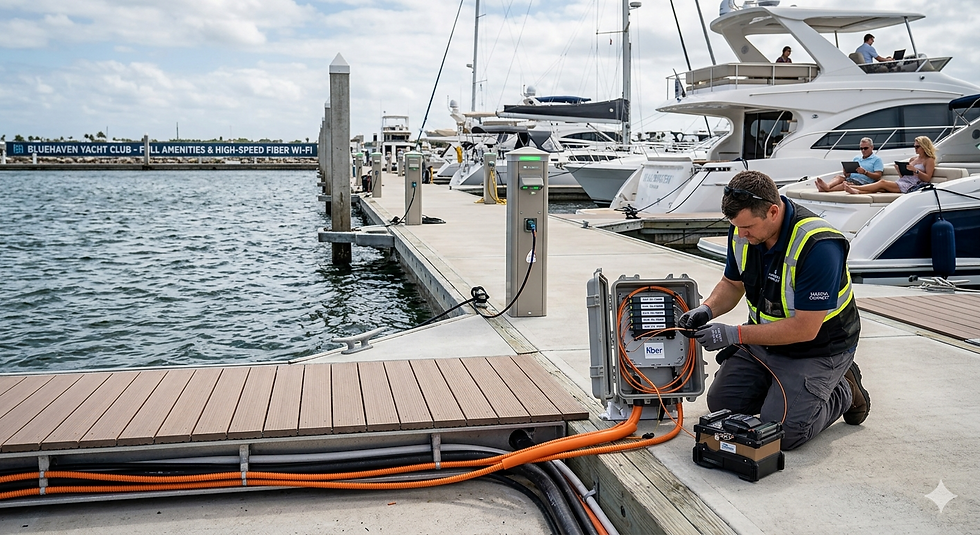
Why Fiber Optics is the Ultimate Maritime Solution
Fiber optic technology transmits data as pulses of light through strands of glass or plastic, completely rewriting the rules of marina networking. Here is why fiber is the ultimate solution for waterfront properties:
1. Complete Immunity to Corrosion and Environment
Because fiber optic cables are made of glass and encased in specialized waterproof, UV-resistant shielding, they are entirely immune to salt air, moisture, and water submersion. While a copper network might require rewriting or replacing rusted connectors every few years, a properly installed marine-grade fiber network can last for decades with virtually zero environmental degradation.
2. Zero Interference from Shore Power
Light waves traveling through glass do not conduct electricity. This means fiber optic cables are 100% immune to electromagnetic interference (EMI). Marina engineers can run fiber data lines directly alongside high-voltage shore power cables in the exact same conduits or dock troughs without any fear of signal cross-talk or performance loss.
3. Infinite Bandwidth and Distance Capabilities
Unlike copper, fiber optics can carry massive amounts of data over miles without losing signal strength. Whether your marina has 50 slips or 500 stretching far out into a harbor, every single pedestal receives the exact same blazing-fast, low-latency connection. Furthermore, fiber offers symmetrical speeds—meaning upload speeds are just as fast as download speeds—which is crucial for boaters uploading large navigation charts or participating in video conference calls.
4. Lightning and Surge Protection
Marinas are prime targets for lightning strikes. Copper cables act as giant antennas; a strike at the end of a dock can travel down the wire, frying network switches, cameras, and even the electronics on connected vessels. Because fiber is non-conductive, it cannot carry an electrical surge. It acts as a natural firewall, protecting your marina’s expensive core infrastructure from lightning damage.

Beyond Wi-Fi: Unlocking Smart Marina Capabilities
Upgrading to fiber optics isn’t just about providing better Wi-Fi for guests; it lays the digital foundation for a fully automated, revenue-generating Smart Marina. With a fiber backbone, operators can seamlessly integrate:
Fiber-to-the-Pedestal (FTTP): Deliver dedicated, hardwired internet jacks directly to individual slips. This allows superyachts and long-term tenants to plug directly into gigabit-speed internet.
Advanced Security and Surveillance: Deploy high-definition, 4K IP security cameras along the outermost docks, utilizing fiber's ability to transmit massive video data feeds back to the main office without lag.
Smart Utility Metering: Automated meters can instantly track electricity and water usage at each slip, feeding the data directly to management software for accurate billing.
Digital Access Control: Fiber enables reliable, real-time control over electronic dock gates, locker rooms, and clubhouse facilities.
The Bottom Line: An Investment in Retention and Value
In the modern hospitality and maritime industries, Wi-Fi is no longer viewed as a luxury perk—it is viewed as a utility, just like water and electricity. In fact, reviews on platforms like Snag-A-Slip or ActiveCaptain frequently cite poor internet as a primary reason for leaving a negative marina review. Conversely, a marina boasting guaranteed, high-speed fiber internet can command premium slip rates and attract high-value transient boaters who rely on steady connectivity to live and work aboard.
While the initial installation of a fiber optic network requires upfront capital, the return on investment is undeniable. By drastically reducing ongoing maintenance costs, eliminating environmental downtime, and opening the door to smart marina technologies, fiber optics ensures your marina won't just keep up with the digital tide—it will lead the fleet.
CONTACT OGS MARINE SYSTEMS TODAY FOR A FREE DESIGN, CONSULTATION AND QUOTE.


Comments